2.4 - Clean Air Act and Montreal Protocol
Regulatory verification date: August 6, 2026
Primary authorities: Title VI of the Clean Air Act, 40 CFR Part 82, current U.S. Environmental Protection Agency ozone-depleting-substance phaseout resources, and the official Montreal Protocol text and Ozone Secretariat resources
Course role: Explains how the international ozone-protection agreement and U.S. federal law work together, and distinguishes refrigerant production and import phaseouts from continued lawful servicing of existing equipment
Learning Objectives
After completing this section, a student should be able to:
- Distinguish the Montreal Protocol from the Clean Air Act and explain the role of each.
- Identify the Clean Air Act provisions that address ozone-depleting-substance phaseout and refrigerant management.
- Explain the difference between a production or import phaseout and an equipment-use prohibition.
- Identify the major U.S. CFC and HCFC phaseout milestones commonly tested on EPA Section 608 examinations.
- Explain how previously produced, recovered, recycled, or reclaimed refrigerant can support continued servicing of existing equipment where permitted.
- Recognize outdated or incomplete phaseout statements in older study guides and replace them with current, properly qualified information.
Introduction
The science developed in Section 2.1 - The Ozone Layer, Section 2.2 - Ozone Depletion Process, and Section 2.3 - Refrigerant Families ODP and GWP explains why chlorine- and bromine-containing substances must be controlled.
Two legal frameworks are especially important:
- The Montreal Protocol on Substances that Deplete the Ozone Layer, an international agreement.
- Title VI of the U.S. Clean Air Act, the domestic federal authority under which EPA implements ozone-protection programs in the United States.
The Montreal Protocol establishes international commitments to control the production and consumption of ozone-depleting substances. The Clean Air Act authorizes EPA to implement and enforce U.S. phaseout schedules, refrigerant-management rules, technician-certification requirements, substitute evaluations, labeling, and related programs.
A critical examination and field-practice distinction is:
A phaseout of production or import is not automatically a prohibition on operating or servicing every piece of existing equipment that contains the refrigerant.
Existing equipment may continue to operate and may be serviced with legally available refrigerant, subject to all applicable recovery, recycling, reclamation, sales, venting, service-practice, and equipment requirements.
Key Concepts
1. The Montreal Protocol Is an International Agreement
The Montreal Protocol on Substances that Deplete the Ozone Layer is a global agreement designed to protect stratospheric ozone by phasing out the production and consumption of controlled ozone-depleting substances.
The agreement was:
- Adopted and signed in 1987.
- Entered into force on January 1, 1989.
- Adjusted and amended over time as scientific knowledge, technology, and international policy developed.
The Protocol establishes:
- Lists of controlled substances.
- Production and consumption control schedules.
- Reporting and trade provisions.
- Different implementation schedules for developed and developing countries.
- Procedures for adjustments and amendments.
- Financial and technical assistance mechanisms, including the Multilateral Fund.
The Protocol does not function as a technician service manual. Each country implements its obligations through its own laws and regulations.
2. “Consumption” Has a Specific Treaty Meaning
In ordinary speech, consumption can mean using a refrigerant in equipment. Under the Montreal Protocol, the term is a national supply-accounting quantity.
The Protocol defines consumption as:
The treaty definition of production also excludes specified destroyed quantities and quantities entirely used as feedstock. Recycled and reused material is not counted as new production.
Therefore:
- A national consumption phaseout does not necessarily mean that every existing appliance must stop operating.
- Refrigerant already present in equipment is not the same as newly produced controlled substance.
- Recovered, recycled, reclaimed, and previously produced supplies can remain important after virgin production declines or ends.
3. The Clean Air Act Provides U.S. Legal Authority
Congress amended the Clean Air Act in 1990 to add Title VI — Stratospheric Ozone Protection.
Title VI directs EPA to establish multiple ozone-protection programs. The sections most relevant to this course include:
| Clean Air Act Provision | General Role |
|---|---|
| Section 602 | Lists Class I and Class II controlled ozone-depleting substances |
| Section 604 | Establishes U.S. phaseout targets for Class I substances |
| Section 605 | Establishes U.S. phaseout targets for Class II substances |
| Section 608 | Establishes the National Recycling and Emission Reduction Program for stationary refrigeration and air-conditioning equipment |
| Section 609 | Establishes motor-vehicle air-conditioning servicing requirements |
| Section 611 | Establishes labeling requirements |
| Section 612 | Establishes the Significant New Alternatives Policy program |
This distinction is important:
- Sections 604 and 605 primarily establish production and import phaseout targets.
- Section 608 primarily addresses refrigerant handling, emissions reduction, technician certification, recovery, recycling, reclamation, sales, service practices, and disposal.
The phrase “Section 608 phaseout date” is therefore imprecise. The phaseout schedules are implemented under the broader Title VI framework, while Section 608 controls how refrigerants are handled during service and disposal.
4. U.S. Regulations Implement International Commitments
The United States is a Party to the Montreal Protocol. EPA uses Clean Air Act authority to implement U.S. obligations and may adopt domestic requirements that are more stringent or accelerated where authorized.
The relationship can be summarized as follows:
Ozone-depletion science
→ international commitments under the Montreal Protocol
→ U.S. authority under Clean Air Act Title VI
→ EPA regulations and compliance programs
→ technician, owner, seller, manufacturer, importer, and disposer responsibilities
The Montreal Protocol and the Clean Air Act are related but are not interchangeable.
| Feature | Montreal Protocol | Clean Air Act Title VI |
|---|---|---|
| Legal level | International agreement | U.S. federal law |
| Main function | Establishes international control commitments | Authorizes U.S. implementation and enforcement |
| Primary controlled activity | National production and consumption of controlled substances | Production, import, handling, servicing, sales, substitutes, labeling, disposal, and other domestic activities |
| Direct technician examination relevance | International purpose and phaseout concepts | U.S. service and compliance requirements |
| Enforcement | Through each Party’s implementation and international compliance mechanisms | Through EPA and the U.S. legal system |
5. Phaseout Does Not Automatically Mean Equipment-Use Ban
A production phaseout reduces and eventually ends the legal production of specified virgin controlled substances, subject to any authorized exemptions.
An import phaseout restricts or ends import of newly produced controlled substances for specified uses.
An equipment-use prohibition would directly prohibit operation, servicing, manufacture, installation, or use of specified equipment or refrigerant in a stated application.
These are different regulatory actions.
For CFC and HCFC phaseouts:
- Existing equipment was not automatically required to be retired on the production phaseout date.
- EPA did not generally require immediate conversion of every existing system.
- Existing equipment can continue to be serviced with legally available material.
- Separate regulations may restrict new equipment manufacture, particular uses, installation, sales, or servicing practices.
- The refrigerant must still be recovered and managed in compliance with Section 608.
The controlling question is not simply:
“Has this refrigerant been phased out?”
The correct questions are:
- What activity was phased out?
- On what date?
- Does the rule concern production, import, manufacture, installation, sale, servicing, or operation?
- Is the equipment existing or newly manufactured?
- Is the refrigerant virgin, previously produced, recovered, recycled, or reclaimed?
- What Section 608 service requirements still apply?
CFC and Class I Phaseout Concepts
1. Class I Substances
Class I ozone-depleting substances generally have higher ozone-depletion potential than Class II substances.
Important Class I substances include:
- CFCs.
- Halons.
- Carbon tetrachloride.
- Methyl chloroform.
- Methyl bromide.
- Hydrobromofluorocarbons.
The different Class I substances did not all share one phaseout date.
2. Major U.S. Class I Dates
EPA identifies the following major production and import milestones:
| Substance Group | Major U.S. Production and Import Milestone |
|---|---|
| Halons | Ban effective January 1, 1994, subject to authorized exceptions |
| Most other Class I ODS, including CFCs | Ban effective January 1, 1996, subject to authorized exceptions |
| Methyl bromide | Production and import phased out on December 31, 2004, subject to authorized exemptions |
For EPA Section 608 preparation, the principal memorization item is:
CFC production and import phaseout date: January 1, 1996.
This is a production and import date. It is not a universal prohibition on every use of every CFC-containing appliance.
3. Continued CFC Equipment Operation
After the CFC production and import phaseout:
- Existing CFC equipment could continue to operate.
- Previously produced CFC inventory could remain available.
- Refrigerant recovered from equipment could be returned to the same owner’s equipment under applicable rules.
- Recycled refrigerant could be reused for the same owner without meeting the full reclamation specification.
- Reclaimed refrigerant could be sold or transferred for use by another owner after processing by an EPA-certified reclaimer.
- Section 608 recovery and venting requirements continued to apply.
The practical purpose of recovery, recycling, and reclamation was partly to avoid unnecessary early retirement of useful equipment while the market transitioned to alternatives.
HCFC and R-22 Phaseout Concepts
1. Class II Substances
Class II ozone-depleting substances are HCFCs.
HCFCs were used as transitional substitutes for many CFC applications because they generally have lower ODP than CFCs. They still contain chlorine and have nonzero ODP.
Major examples include:
- HCFC-22, commonly called R-22.
- HCFC-123.
- HCFC-124.
- HCFC-141b.
- HCFC-142b.
2. Current U.S. HCFC Phaseout Schedule
EPA’s current Class II phaseout table identifies the following U.S. milestones:
| Year | U.S. Phaseout Action |
|---|---|
| 2003 | No production or import of HCFC-141b |
| 2010 | No production or import of HCFC-22 and HCFC-142b except for use in equipment manufactured before January 1, 2010 |
| 2015 | No production or import of other HCFCs except as refrigerants in equipment manufactured before January 1, 2020 |
| 2020 | No production or import of HCFC-22 and HCFC-142b |
| 2030 | No production or import of any HCFCs |
The 2030 milestone has not yet occurred.
3. Meaning of the 2020 R-22 Milestone
The commonly tested “R-22 phaseout date” is:
January 1, 2020 — U.S. production and import of HCFC-22 for ordinary servicing use ended.
The 2020 milestone did not mean:
- Every R-22 system became illegal.
- Every R-22 appliance had to be replaced.
- Technicians could no longer recover R-22.
- Reclaimed R-22 became illegal.
- Existing equipment could no longer be repaired.
After 2020, existing R-22 equipment may continue to be serviced with:
- R-22 produced or imported before the phaseout.
- Recovered R-22 reused where permitted.
- Recycled R-22 reused where permitted.
- Reclaimed R-22 processed by an EPA-certified reclaimer.
All applicable Section 608 requirements remain in force.
4. The Complete HCFC Phaseout Continues Through 2030
Another common mistake is to state that all HCFC production and import ended in 2020.
The correct distinction is:
- 2020: Production and import of HCFC-22 and HCFC-142b ended.
- 2030: Production and import of all remaining HCFCs is scheduled to end.
For example, virgin HCFC-123 and HCFC-124 remain subject to a declining allowance system and use restrictions before the final 2030 step.
Recovered, Recycled, Reclaimed, and Previously Produced Refrigerant
1. Previously Produced Refrigerant
Previously produced refrigerant is virgin refrigerant legally produced or imported before the applicable phaseout date and retained in inventory.
A production phaseout does not normally destroy lawful existing inventory. Previously produced material may remain available subject to applicable restrictions.
2. Recovered Refrigerant
Recovered refrigerant has been removed from an appliance and stored in an external container without necessarily being processed to a specified purity.
Recovered refrigerant may be returned to the same appliance or handled through another allowed pathway, subject to the applicable rules.
3. Recycled Refrigerant
Recycled refrigerant has been extracted and cleaned for reuse without meeting every requirement for reclamation.
For stationary equipment, recycled refrigerant is generally limited to reuse in equipment owned by the same person who owned the equipment from which the refrigerant was recovered.
4. Reclaimed Refrigerant
Reclaimed refrigerant has been processed to the required purity specification and verified using the applicable analytical method.
Used refrigerant generally must be reclaimed by an EPA-certified reclaimer before it is sold or transferred to a different owner for use as refrigerant.
5. Why These Pathways Matter After Phaseout
Recovery, recycling, and reclamation:
- Reduce atmospheric emissions.
- Conserve existing refrigerant supplies.
- Support continued servicing of existing equipment.
- Reduce demand for newly produced controlled substances.
- Delay unnecessary equipment retirement.
- Help owners transition during normal equipment replacement cycles.
Detailed recovery, recycling, reclamation, ownership, purity, and transfer requirements are developed in Module 5.
Regulatory Updates and Legacy Study-Guide Warnings
1. “R-22 Was Banned in 2020”
This statement is incomplete and often misleading.
A better statement is:
New production and import of HCFC-22 ended in the United States on January 1, 2020. Existing equipment may continue to operate and may be serviced with legally available previously produced, recovered, recycled, or reclaimed R-22.
2. “All HCFCs Were Phased Out in 2020”
This is incorrect.
The 2020 step applied to HCFC-22 and HCFC-142b. The complete U.S. phaseout of production and import of all HCFCs is scheduled for 2030.
3. “A Production Phaseout Means Existing Equipment Must Be Replaced”
This is generally incorrect for the CFC and HCFC phaseout milestones discussed here.
EPA did not impose a general requirement that every existing CFC or R-22 system be immediately replaced when virgin production ended. Separate use restrictions, codes, technology-transition rules, and equipment requirements may apply in particular situations.
4. “Recovered and Reclaimed Mean the Same Thing”
This is incorrect.
- Recovery removes refrigerant.
- Recycling performs limited cleaning for reuse.
- Reclamation processes refrigerant to the required purity specification and permits broader transfer or resale under the applicable rules.
5. “The Montreal Protocol Only Covers Ozone-Depleting Refrigerants”
The original agreement focused on ozone-depleting substances. The Kigali Amendment, adopted in 2016, added a phase-down of HFC production and consumption because many HFCs are powerful greenhouse gases.
HFCs have zero ODP. Their phase-down is a climate action under the Montreal Protocol framework, not evidence that HFCs deplete ozone.
In the United States, HFC phase-down and technology-transition requirements are implemented principally under the American Innovation and Manufacturing Act of 2020, commonly called the AIM Act. The AIM Act is discussed separately in Section 2.8 - Current and Historical Regulation Comparison.
6. Older Dates Must Be Labeled
An older study guide may correctly report the rule that existed when it was published but no longer describe the current schedule.
Every regulatory date should be identified as one of the following:
- Current.
- Historical.
- Scheduled future requirement.
- Superseded.
- Provider-specific examination wording.
Technical and Regulatory Details
1. Class I and Class II Are Legal Categories
| Category | Main Substance Group | General ODP Pattern | U.S. Phaseout Provision |
|---|---|---|---|
| Class I | CFCs, halons, and other listed substances | Generally higher ODP | Clean Air Act Section 604 |
| Class II | HCFCs | Generally lower but nonzero ODP | Clean Air Act Section 605 |
The class designation is a legal classification, not an ASHRAE safety classification and not a Section 608 technician-certification type.
2. Phaseout and Section 608 Operate Together
Phaseout rules reduce the supply of virgin ODS. Section 608 rules reduce emissions and preserve available refrigerant.
| Phaseout Program | Section 608 Program |
|---|---|
| Controls production and import | Controls handling during service and disposal |
| Uses national allowances and schedules | Uses technician, equipment, service-practice, sales, and recordkeeping requirements |
| Reduces new virgin supply | Promotes recovery, reuse, recycling, reclamation, and emission reduction |
| Applies to manufacturers, importers, exporters, and controlled-substance markets | Applies to technicians, owners, operators, sellers, reclaimers, and disposers, depending on the activity |
A technician must not treat reduced refrigerant availability as permission to vent, mix refrigerants, use an unapproved substitute, or bypass recovery requirements.
3. Phaseout Does Not Make Every Substitute Acceptable
The phaseout of a CFC or HCFC does not authorize any other substance as a replacement.
A substitute must be:
- Acceptable for the specific end use under EPA’s SNAP program where applicable.
- Compatible with the equipment and lubricant.
- Used in accordance with manufacturer instructions.
- Used in accordance with safety standards, codes, and charge limits.
- Handled by personnel with the required certification and training.
There are no universal drop-in replacements.
4. Current Status
| Topic | Current Status |
|---|---|
| Most CFC production and import | Ended January 1, 1996, subject to limited authorized exceptions |
| Existing CFC equipment | May continue to operate and be serviced with legally available refrigerant |
| HCFC-22 and HCFC-142b production and import | Ended January 1, 2020 for ordinary use |
| Existing R-22 equipment | May continue to operate and be serviced with legally available supplies |
| Remaining HCFC production and import | Subject to declining controls and scheduled to end in 2030 |
| Section 608 recovery and venting requirements | Continue to apply |
| HFC phase-down | Separate current program under the Kigali Amendment and U.S. AIM Act |
Important Terms
Adjustment
An adjustment changes the control measures for substances already covered by the Montreal Protocol through the treaty’s established procedure.
Amendment
An amendment changes the treaty, such as by adding new substances, obligations, or provisions. Ratification requirements apply according to the treaty framework.
Class I Substance
A Class I substance is an ozone-depleting substance listed in the applicable Clean Air Act category, including CFCs, halons, and other specified compounds.
Class II Substance
A Class II substance is an HCFC listed under the Clean Air Act ozone-protection provisions.
Consumption
Under the Montreal Protocol, consumption is production plus imports minus exports of controlled substances. It is not simply the amount of refrigerant operating inside equipment.
Montreal Protocol
The Montreal Protocol is the international agreement that controls the production and consumption of ozone-depleting substances and, through the Kigali Amendment, phases down HFCs.
Phaseout
A phaseout is a scheduled reduction leading to elimination or near-elimination of a specified controlled activity, such as production or import.
Previously Produced Refrigerant
Previously produced refrigerant is material lawfully produced or imported before the applicable production or import restriction took effect.
Production
Under the Montreal Protocol, production is a defined national accounting quantity for controlled substances. Specified destruction and feedstock uses are excluded, and recycled or reused material is not counted as new production.
Reclaim
To reclaim refrigerant means to process it to the required purity specification and verify that purity using the prescribed analytical method.
Recover
To recover refrigerant means to remove it from an appliance and store it in an external container without necessarily testing or processing it.
Recycle
To recycle refrigerant means to extract and clean it for reuse without meeting all reclamation requirements.
Title VI
Title VI of the Clean Air Act is the part of U.S. federal law addressing stratospheric ozone protection.
Figures and Diagrams
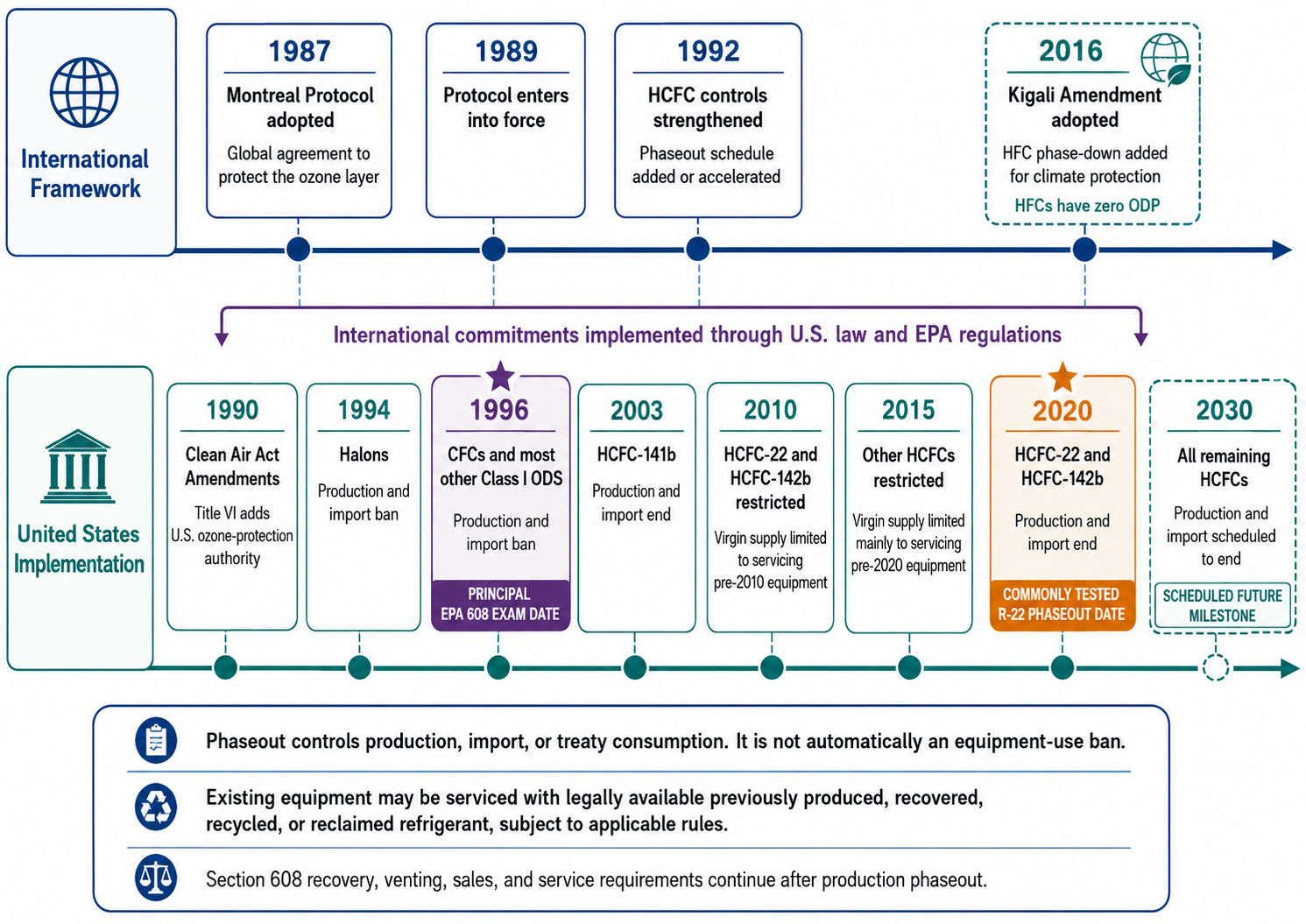
Figure 2.4.1 – Relationship between the Montreal Protocol, U.S. Clean Air Act implementation, and major CFC and HCFC phaseout milestones.
AI-generated instructional figure: It may contain visual inaccuracies. Use the accompanying lesson text and cited authoritative sources to verify technical and regulatory details.
EPA 608 Exam Focus
What Students Must Remember
- The Montreal Protocol is an international agreement.
- The Clean Air Act is U.S. federal law.
- Title VI of the Clean Air Act provides U.S. ozone-protection authority.
- Section 604 addresses Class I phaseout targets.
- Section 605 addresses Class II phaseout targets.
- Section 608 addresses recycling, emissions reduction, technician certification, and service practices.
- The Montreal Protocol was adopted in 1987 and entered into force in 1989.
- The principal U.S. CFC production and import phaseout date is January 1, 1996.
- The commonly tested R-22 production and import phaseout date is January 1, 2020.
- The 2020 date applies specifically to HCFC-22 and HCFC-142b, not every HCFC.
- Production and import of all remaining HCFCs is scheduled to end in 2030.
- A production phaseout is not automatically an equipment-use prohibition.
- Existing R-22 equipment may continue to operate and be serviced with legally available refrigerant.
- Recovery, recycling, reclamation, sales, venting, and service-practice requirements continue after production phaseout.
- Recycled refrigerant is generally limited to equipment of the same owner.
- Reclaimed refrigerant can enter broader commerce after processing by an EPA-certified reclaimer.
- The Kigali Amendment concerns HFC phase-down for climate protection; HFCs have zero ODP.
- Current U.S. HFC controls are principally implemented under the AIM Act, not the CFC and HCFC ODS phaseout schedule.
Typical Exam Question Patterns
Students may be asked to:
- Identify the Montreal Protocol as an international agreement.
- Identify the Clean Air Act as U.S. federal law.
- Select the 1996 CFC phaseout date.
- Select the 2020 R-22 production and import phaseout date.
- Explain whether existing R-22 equipment had to be replaced in 2020.
- Distinguish production phaseout from equipment-use prohibition.
- Identify the role of recovered, recycled, or reclaimed refrigerant.
- Identify the final 2030 U.S. HCFC production and import milestone.
- Distinguish Class I from Class II substances.
- Explain why the Kigali Amendment does not mean HFCs deplete ozone.
- Recognize an outdated statement in an older study guide.
High-Priority Timeline
| Date | Exam Association |
|---|---|
| 1987 | Montreal Protocol adopted |
| 1989 | Montreal Protocol enters into force |
| 1990 | Clean Air Act Amendments add Title VI |
| 1996 | CFC production and import phaseout |
| 2010 | Virgin R-22 restricted to servicing pre-2010 equipment |
| 2020 | HCFC-22 and HCFC-142b production and import end |
| 2030 | All remaining HCFC production and import scheduled to end |
Common Mistakes and Confusing Points
Mistake 1: Calling the Montreal Protocol a U.S. Law
The Montreal Protocol is an international agreement. The Clean Air Act is the U.S. federal law used for domestic implementation.
Mistake 2: Saying Section 608 Created Every Phaseout Date
Clean Air Act Sections 604 and 605 establish Class I and Class II phaseout targets. Section 608 addresses refrigerant handling and emission reduction.
Mistake 3: Interpreting Treaty Consumption as Appliance Operation
Montreal Protocol consumption is a national accounting quantity, not the amount operating inside an appliance.
Mistake 4: Saying CFC Use Became Universally Illegal in 1996
The major 1996 milestone ended production and import of most Class I substances. Existing equipment and legally available supplies could continue under applicable rules.
Mistake 5: Saying Every R-22 System Became Illegal in 2020
The 2020 milestone ended new production and import of HCFC-22 for ordinary use. Existing systems may continue to operate and be serviced with legal supplies.
Mistake 6: Saying All HCFCs Ended in 2020
The 2020 milestone applied to HCFC-22 and HCFC-142b. The final U.S. HCFC production and import phaseout is scheduled for 2030.
Mistake 7: Treating Recovered, Recycled, and Reclaimed as Synonyms
The terms describe different levels of removal, cleaning, purity verification, and permitted transfer.
Mistake 8: Assuming a Phaseout Cancels Section 608 Requirements
Recovery, venting, sales, service-practice, equipment, and recordkeeping rules continue to apply.
Mistake 9: Assuming Any Substitute Is Automatically Allowed
A replacement must be acceptable for the end use and compatible with the equipment, lubricant, safety requirements, and codes.
Mistake 10: Assuming HFC Control Proves HFC Ozone Depletion
HFCs have zero ODP. Kigali and AIM Act controls address climate impact.
Concept-Check Questions
Question 1
Which statement best describes the Montreal Protocol?
A. It is a U.S. technician-certification regulation administered only by EPA.
B. It is an international agreement controlling the production and consumption of ozone-depleting substances.
C. It is an ASHRAE refrigerant-safety standard.
D. It is a state HVAC contractor-licensing program.
Question 2
Which Clean Air Act provision primarily establishes the National Recycling and Emission Reduction Program for stationary refrigeration and air-conditioning equipment?
A. Section 602
B. Section 604
C. Section 608
D. Section 612
Question 3
What is the principal U.S. CFC production and import phaseout date commonly tested on the EPA Section 608 examination?
A. January 1, 1996
B. January 1, 2003
C. January 1, 2010
D. January 1, 2020
Question 4
What did the January 1, 2020 R-22 milestone primarily mean?
A. Every R-22 appliance had to be destroyed.
B. Technicians could no longer recover R-22.
C. All HCFC production and import ended permanently.
D. U.S. production and import of HCFC-22 and HCFC-142b ended for ordinary use.
Question 5
Which statement about existing R-22 equipment after 2020 is most accurate?
A. The equipment became illegal to operate.
B. It may continue to operate and may be serviced with legally available previously produced, recovered, recycled, or reclaimed refrigerant.
C. Only newly produced R-22 may be used.
D. Section 608 no longer applies because virgin production ended.
Question 6
When is U.S. production and import of all remaining HCFCs scheduled to end?
A. 1996
B. 2010
C. 2030
D. 2047
Question 7
Under the Montreal Protocol, what does consumption mean?
A. Production plus imports minus exports
B. Refrigerant charge multiplied by annual leakage rate
C. Total refrigerant operating inside all appliances
D. Production minus recycled refrigerant only
Question 8
Which statement about the Kigali Amendment is correct?
A. It proves that HFCs contain chlorine and deplete ozone.
B. It replaces all Section 608 technician-certification requirements.
C. It ended operation of all existing HFC equipment in 2016.
D. It added an international HFC phase-down for climate protection even though HFCs have zero ODP.
Answers and detailed explanations will be provided in
2.11 - Answers and Explanations.md.
Section Summary
The Montreal Protocol and the Clean Air Act form related but distinct parts of ozone protection.
- The Montreal Protocol is an international agreement.
- Title VI of the Clean Air Act provides U.S. legal authority.
- Clean Air Act Sections 604 and 605 establish Class I and Class II phaseout targets.
- Section 608 establishes refrigerant-management and emission-reduction requirements for stationary equipment.
The principal examination dates are:
- 1987: Montreal Protocol adopted.
- 1989: Montreal Protocol enters into force.
- 1996: U.S. production and import of CFCs and most other Class I substances ends.
- 2020: U.S. production and import of HCFC-22 and HCFC-142b ends.
- 2030: U.S. production and import of all remaining HCFCs is scheduled to end.
A production or import phaseout does not automatically prohibit continued operation of existing equipment. Legally available previously produced, recovered, recycled, or reclaimed refrigerant can support continued servicing, while all applicable Section 608 requirements continue.
Older study guides must be read carefully. Statements such as “R-22 was banned in 2020” or “all HCFCs ended in 2020” are incomplete or incorrect unless the controlled activity and substance are clearly identified.
References
Current U.S. Environmental Protection Agency Sources
-
U.S. Environmental Protection Agency, Ozone Protection under Title VI of the Clean Air Act, accessed August 6, 2026.
-
U.S. Environmental Protection Agency, Phaseout of ODS Under the Clean Air Act, accessed August 6, 2026.
-
U.S. Environmental Protection Agency, Phaseout of Class I Ozone-Depleting Substances, accessed August 6, 2026.
-
U.S. Environmental Protection Agency, Phaseout of Class II Ozone-Depleting Substances, accessed August 6, 2026.
-
U.S. Environmental Protection Agency, Technicians and Contractors: Frequent Questions, accessed August 6, 2026.
-
U.S. Environmental Protection Agency, Homeowners and Consumers: Frequently Asked Questions, accessed August 6, 2026.
-
U.S. Environmental Protection Agency, Purchasing and Repairing Home Air-Conditioners or Heat Pumps, accessed August 6, 2026.
-
U.S. Environmental Protection Agency, Commercial Refrigeration and Air Conditioning Equipment: Frequent Questions, accessed August 6, 2026.
-
U.S. Environmental Protection Agency, Stationary Refrigeration and Air Conditioning, accessed August 6, 2026.
-
U.S. Environmental Protection Agency, Section 608 Test Topics, accessed August 6, 2026.
-
U.S. Environmental Protection Agency, Background on HFCs and the AIM Act, accessed August 6, 2026.
International and Treaty Sources
-
United Nations Environment Programme Ozone Secretariat, The Montreal Protocol on Substances that Deplete the Ozone Layer, accessed August 6, 2026.
-
United Nations Environment Programme Ozone Secretariat, Montreal Protocol Text as Adjusted and Amended, accessed August 6, 2026.
-
United Nations Environment Programme Ozone Secretariat, Ozone Timeline, accessed August 6, 2026.
Current Regulatory Text
-
Electronic Code of Federal Regulations, 40 CFR Part 82, Subpart A — Production and Consumption Controls, accessed August 6, 2026.
-
Electronic Code of Federal Regulations, 40 CFR Part 82, Subpart F — Recycling and Emissions Reduction, accessed August 6, 2026.